
Guide for Wheat Procurement Strategy in India

How Large-Scale Wheat Procurement Strategy Works in India
India’s wheat economy is not just about farming. It is a complete movement of grain from field to mandi, mandi to warehouse, warehouse to mill, and finally to households, processors, exporters, and food security systems. That is why a strong wheat procurement strategy matters. It decides how wheat is sourced, tested, priced, stored, transported, and sold at scale. Today, alongside MSP and FCI procurement, private buyers, flour mills, exporters, and commodity traders are building more organized sourcing systems. For businesses, procurement is no longer only about price. It is about timing, quality, storage, logistics, and trust.

This guide explains how large-scale wheat procurement works in India, from mandi operations and quality grading to storage, logistics, profitability, and modern sourcing strategies.
How Big Is the Wheat Procurement Market in India?
To understand wheat procurement in India, first look at the scale.
India remains one of the world’s largest wheat producers. The Ministry of Agriculture estimated India’s wheat production for 2024-25 at 1175.07 lakh metric tonnes, reflecting the crop’s critical role in the country’s food system.
Wheat is consumed across Indian homes, flour mills, bakeries, food processors, institutional kitchens, and export channels. Government agencies procure wheat mainly to maintain buffer stocks and support food security programs, while private buyers procure for processing, trading, storage, and resale.
In 2026, the government reportedly raised its wheat procurement target by 15% to 34.5 million tonnes, while also approving additional exports to support prices and manage stock pressure. This shows how closely wheat procurement is linked with farmer income, food inflation, storage capacity, and market stability.
A practical wheat procurement strategy must therefore account for two parallel markets: government-backed MSP wheat procurement and private market procurement. FCI wheat procurement provides a pricing floor and large-scale demand, while private procurement responds more directly to quality, location, buyer demand, transport cost, and seasonal price movement.
For businesses, the opportunity lies in organized sourcing. Flour mills need consistent wheat quality. Exporters need reliable aggregation. Processors need timely supply. Traders need price visibility. This is where the wheat supply chain India is gradually becoming more structured, data-led, and professionally managed.
Which States Dominate Wheat Procurement in India?
Wheat procurement in India is strongly regional. Punjab, Haryana, Madhya Pradesh, and Uttar Pradesh are among the most important states in the wheat procurement ecosystem as per the Government report.
Punjab and Haryana continue to lead because they have mature mandi networks, strong MSP wheat procurement systems, better aggregation infrastructure, and long-standing farmer-government procurement linkages. Wheat arrivals are more predictable, procurement centers are better organized, and logistics from mandis to storage points are relatively smoother.
Madhya Pradesh has become a major wheat procurement hub because of rising production, quality wheat varieties, improved mandi operations, and expanding procurement infrastructure. For many private buyers, MP offers an attractive mix of volume, quality, and pricing opportunity.
Uttar Pradesh is one of India’s largest wheat-producing states, but procurement is more fragmented because of its vast geography, smaller farmer holdings, and uneven mandi participation. Still, for a wheat sourcing business, UP cannot be ignored because of its scale and proximity to major consumption markets.
This is why a state-wise wheat procurement strategy matters. A business buying only from one state may face local price spikes, delayed arrivals, climate disruptions, or transport bottlenecks. A smarter approach is to diversify sourcing across multiple mandis, compare landed cost, and build relationships with farmers, aggregators, and mandi-level operators.
How Does Wheat Procurement in India Actually Work?
The mandi procurement process may look simple from outside: farmers bring wheat, buyers inspect it, and payment is made. In reality, every step affects quality, price, risk, and profitability.
A strong wheat procurement strategy begins before wheat reaches the mandi. Procurement teams track sowing patterns, expected harvest, weather changes, local price sentiment, MSP announcements, and buyer demand. By the time arrivals begin, serious buyers already know which regions to prioritize.
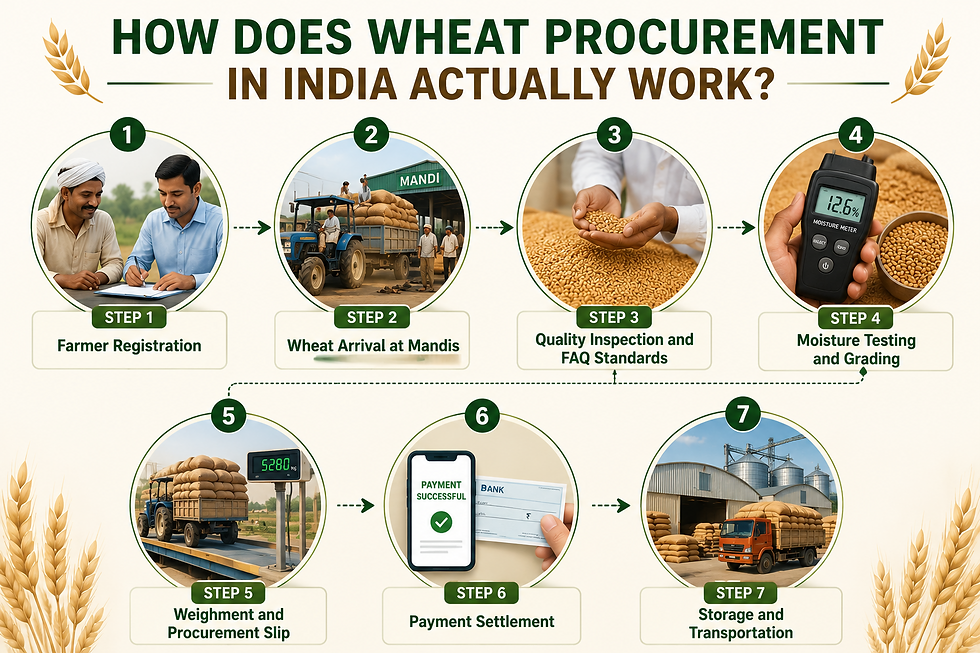
Step 1: Farmer Registration
In government procurement, farmers are often required to register through state systems or procurement portals. The Central Foodgrains Procurement Portal records farmer registration, estimated procurement, and MSP-related transactions across procurement operations.
Private procurement may not always follow the same registration model, but professional buyers still maintain supplier records, farmer contacts, aggregator details, and quality history.
Step 2: Wheat Arrival at Mandis
During peak arrivals, mandis become high-pressure environments. Farmers bring wheat in tractor trolleys or bags. Arthiyas, commission agents, traders, mill buyers, and procurement officials operate simultaneously. Prices can change quickly depending on arrival pressure, moisture levels, and buyer demand.
This is where wheat mandi procurement requires speed and discipline. A buyer who cannot test, weigh, negotiate, and lift stock efficiently may lose both quality lots and price advantage.
Step 3: Quality Inspection and FAQ Standards
FAQ wheat standards, or Fair Average Quality standards, define acceptable parameters such as moisture, damaged grains, foreign matter, shriveled grains, and overall grain condition. Government procurement follows prescribed FAQ norms, and wheat that does not meet standards may be rejected or discounted.
Every wheat procurement strategy should include a clear quality checklist. Moisture is especially important. Even a small difference in moisture can affect storage life, weight loss, pest risk, and resale value.
Step 4: Moisture Testing and Grading
Professional buyers use moisture meters, sampling probes, and physical inspection. Grain is checked for color, smell, grain size, impurities, infestation, and heat damage. In some cases, wheat is graded based on end use. Flour mills may prefer specific grain characteristics, while traders may focus more on bulk movement and price spread.
Step 5: Weighment and Procurement Slip
After quality approval, wheat is weighed through a weighbridge or weighing system. Procurement slips record quantity, quality notes, price, seller details, and transaction references. In organized systems, this information is digitized to reduce disputes and improve traceability.
Step 6: Payment Settlement
In MSP wheat procurement, payments are generally routed through official systems. In private procurement, payment cycles depend on buyer-seller agreements. Faster payment can become a competitive advantage, especially when farmers or aggregators have multiple buyer options.
Step 7: Storage and Transportation
Once wheat is purchased, the next challenge begins: lifting, loading, bagging, transportation, unloading, and storage. Grain logistics can make or break margins. Delayed lifting can expose wheat to weather. Poor loading can cause leakage. Weak warehouse practices can lead to moisture damage or pest attack.
This is why procurement does not end at buying. It ends only when the wheat is safely stored or delivered to the buyer.
How Do Large Wheat Procurement Businesses Make Money?
Large wheat procurement businesses make money through a mix of margin, volume, timing, storage, and buyer relationships.
In a wheat trading business India model, the buyer may purchase wheat from mandis or aggregators and sell it to flour mills, processors, exporters, or institutional buyers. The basic margin comes from the difference between buying price and selling price after deducting transport, labour, storage, finance, mandi charges, and handling losses.
A commercial wheat procurement strategy often includes four profit levers:
Profit Lever | How It Works |
Procurement margin | Buying efficiently from source markets and selling to bulk buyers |
Location arbitrage | Moving wheat from surplus mandis to demand-heavy markets |
Storage gain | Holding wheat when seasonal prices are expected to rise |
Quality premium | Supplying cleaner, graded, and reliable wheat to premium buyers |
However, margins are never guaranteed. Price volatility, moisture loss, delayed payments, storage damage, and sudden policy changes can reduce profitability.
What Is the Best Wheat Procurement Strategy for Indian Businesses?
The best wheat procurement strategy is not one fixed model. It depends on the buyer’s scale, working capital, storage access, and end customer.
For small traders, mandi-based buying may be safer because it requires less direct farmer coordination. For medium aggregators, building farmer and village-level networks can improve sourcing control. For large operators, warehouse-led procurement is often more powerful because it allows bulk storage, quality segregation, and timed selling.
A balanced grain procurement strategy may include:
direct farmer sourcing for trust and better price discovery
mandi procurement for volume and availability
contract aggregation for predictable supply
regional diversification to reduce state-specific risk
warehouse-based storage for seasonal flexibility
digital records for traceability and payment control
The real advantage comes from combining human relationships with data. Procurement teams need mandi intelligence, but they also need price dashboards, weather tracking, stock visibility, and buyer demand forecasting.
How Much Investment Is Needed to Start a Wheat Procurement Business in India?
Wheat procurement costs vary widely depending on scale. A small operator may begin with limited working capital and rented storage, while a large agricultural procurement business may require crores in capital.
Expense Category | Estimated Cost |
Trade License | ₹10,000-₹50,000 |
GST Registration | ₹0-₹5,000 |
Warehouse Deposit | ₹2-₹15 lakh |
Moisture Testing Equipment | ₹25,000-₹2 lakh |
Weighbridge Access | ₹50,000+ |
Labour Setup | ₹50,000-₹3 lakh/month |
Transportation Setup | ₹1-₹10 lakh |
Working Capital | ₹25 lakh-₹5 crore |
The biggest cost is usually not licensing or equipment. It is a working capital. Wheat procurement is a volume business, and payments often need to be made before resale cash comes in.
Hidden costs must also be part of the wheat procurement strategy. These include storage losses, loading-unloading charges, transport leakage, moisture shrinkage, delayed payments, mandi charges, insurance, pest control, and finance cost.
A buyer who ignores these costs may look profitable on paper but lose money in actual operations.
What Equipment Is Required for Professional Wheat Procurement?
Professional wheat procurement requires more than bags and trucks. Equipment improves accuracy, reduces disputes, and protects grain quality.
Essential equipment includes:
moisture meter
weighing systems
grain sampling probes
tarpaulin covers
storage pallets
forklifts or handling equipment
aeration systems
barcode or inventory tracking systems
This is where a modern wheat procurement strategy becomes different from traditional trading. The focus shifts from “buy and move” to “buy, verify, protect, record, and deliver.”
Invade Mill’s positioning around carefully selected grains, hygienic processing, certified quality, and trusted commodity trading aligns well with this professional approach to grain handling and supply reliability.
How Important Are Warehousing and Storage in Wheat Procurement?
Storage is one of the most underestimated parts of wheat procurement in India. A good purchase can become a bad deal if the wheat is stored poorly.
Wheat storage management includes moisture control, pest prevention, ventilation, stack planning, fumigation, and regular inspection. Common storage formats include godowns, CAP storage, silos, and scientific warehouses.
In wheat warehousing India, the goal is simple: protect quantity and quality. Wheat exposed to humidity, heat, rain, or pests can lose weight, develop fungus, or become unsuitable for premium buyers.
For large businesses, storage is not just a safety measure. It is also a commercial tool. If prices rise after the peak arrival season, stored wheat can generate better margins. But this only works when warehouse discipline is strong.
What Licenses and Policies Affect Wheat Procurement?
Wheat procurement businesses may need GST registration, trade license, APMC registration, FSSAI registration, warehouse agreements, transport documents, and e-way bill compliance depending on the state and business model.
On the policy side, MSP, FCI wheat procurement, decentralized procurement, buffer stock norms, and Open Market Sale Scheme decisions influence market behavior. The government approved wheat MSP of ₹2,585 per quintal for RMS 2026–27, up from ₹2,425 in RMS 2025–26.
This matters because MSP acts as a benchmark. Even private buyers must understand MSP levels, since farmers compare private offers with official procurement prices.
What Are the Biggest Challenges in Wheat Procurement in India?
Every procurement season brings uncertainty. Price volatility can shift margins within days. Climate risk can affect yield and quality. Heat stress may lead to shriveled grain or lower output. Logistics delays can increase costs. Storage losses can silently reduce profit.
A resilient wheat procurement strategy should prepare for these risks before the season begins.
Common mistakes include underestimating working capital, ignoring moisture levels, depending on one region, failing to plan transport, and buying without confirmed buyer demand. New entrants often focus only on purchase price. Experienced operators look at landed cost, payment cycle, storage risk, and resale timing.
Is Wheat Procurement Profitable in India?
Yes, wheat procurement can be profitable, but only when managed professionally.
Small traders usually operate on thin margins and quick turnover. Medium aggregators may improve margins through better sourcing and buyer relationships. Large procurement operators can benefit from scale, storage, quality segregation, and stronger institutional networks.
A realistic wheat procurement strategy looks at profitability in layers:
purchase price
transport cost
storage cost
finance cost
handling loss
resale value
payment timing
Profit does not come from buying cheap alone. It comes from controlling the complete movement of grain.
Expert Tips for Building a Successful Wheat Procurement Strategy
A successful wheat procurement strategy is built on discipline.
First, build strong farmer and mandi relationships. Wheat is a relationship-driven business, especially during peak arrivals.
Second, invest in quality testing. Moisture, impurities, and grain condition directly affect resale value.
Third, diversify procurement regions. Punjab, Haryana, MP, and UP behave differently in terms of arrivals, pricing, and logistics.
Fourth, use data. Track mandi prices, weather patterns, storage availability, transport rates, and buyer demand.
Finally, think beyond one season. The best procurement businesses build repeatable systems, not one-time trades.
What Is the Future of Wheat Procurement in India?
The future of wheat procurement in India will be more organized, more digital, and more quality-driven.
Government systems are already moving toward digital procurement records and direct payments. Private businesses are also adopting inventory software, warehouse tracking, quality testing tools, and data-led sourcing decisions.
For businesses, the next advantage will come from combining mandi knowledge with technology. Companies that can source reliably, test accurately, store scientifically, and deliver consistently will lead the next phase of India’s grain supply chain.
That is exactly where a professional wheat procurement strategy becomes valuable.
Looking to build a reliable wheat sourcing network in India? Invade Mill helps businesses streamline agricultural procurement with market intelligence, sourcing expertise, and supply chain support.
From commodity trading to carefully selected grains and food processing, Invade Mill works toward one clear goal: moving better-quality agricultural commodities through cleaner, smarter, and more trusted supply chains.


Comments