
FSSAI Food Safety Management System for Bulk Commodity Processing

A Practical Guide for Bulk Commodity Processing
Food safety failures rarely begin dramatically. They often begin quietly: a truck arrives with hidden moisture, a damaged bag is placed beside approved stock, or a test result is linked to the wrong batch.
In bulk commodity processing, these small gaps can travel far. One grain lot may move through storage, cleaning, milling, packing, and several customer dispatches before a problem becomes visible.
The World Health Organization’s latest estimates say unsafe food causes about 866 million illnesses and 1.52 million deaths annually. Prevention must therefore be built into daily operations.
This is where the FSSAI Food Safety Management System matters. It helps businesses identify risks, apply controls, maintain evidence, and respond when something goes wrong.
What Is the FSSAI Food Safety Management System?
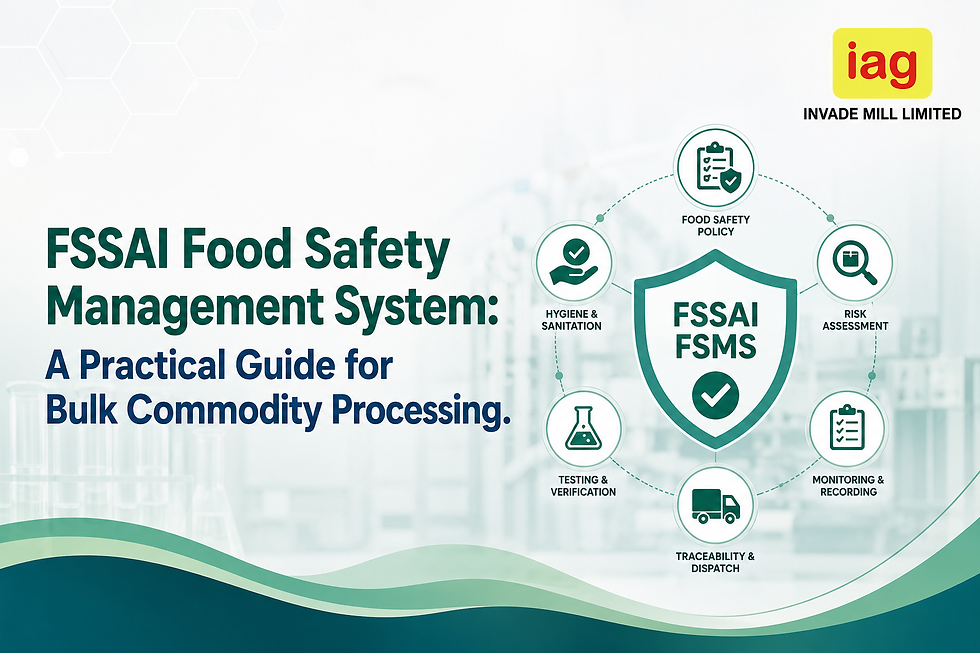
The FSSAI Food Safety Management System, commonly called FSMS, is a documented framework for identifying, controlling, monitoring, and recording food-safety risks. It brings together hygiene practices, manufacturing controls, employee responsibilities, hazard management, verification, documentation, and corrective action.
FSSAI states that every Food Business Operator applying for a licence must have a documented FSMS plan and comply with Schedule 4 of the Food Safety and Standards (Licensing and Registration of Food Businesses) Regulations, 2011. Part II applies to manufacturing, processing, packaging, storage, and distribution operations.
In practical terms, an FSMS asks what could make food unsafe, where it could occur, which control will prevent it, who will monitor that control, and what happens when a requirement is not met. The procedures must match the facility’s actual commodities, equipment, people, layout, and processing steps.
Why FSMS Matters in Bulk Commodity Processing
Bulk commodity processing handles large volumes through shared systems such as conveyors, storage bins, cleaning lines, mills, and packing areas. This scale improves efficiency, but it also increases the impact of a single food safety failure. Excess moisture, hidden infestation, foreign matter, chemical contamination, poor sanitation, or incorrect batch identification can spread across multiple production lots before the issue is detected.
For example, a wheat consignment may appear acceptable from the outside while grain deeper in the load contains damp pockets, insects, mould, or other contaminants. If the material is unloaded without proper inspection, representative sampling, testing, and segregation, it may mix with approved stock and become difficult to trace.
An FSSAI Food Safety Management System addresses this risk through documented controls at every stage, from supplier approval and intake inspection to processing, storage, testing, packing, and dispatch.
What Are the Core Components of an FSSAI FSMS?
An effective FSSAI FSMS combines preventive hygiene practices, operational controls, hazard management, continuous monitoring, and documented corrective action to maintain food safety at every stage of processing.
Good Manufacturing Practices
Good Manufacturing Practices, or GMP, create the physical and operational foundation for safe production. They cover facility design, equipment suitability, maintenance, ventilation, lighting, drainage, waste disposal, water quality, and separation of food and non-food materials.
In a flour mill, this includes clean product-contact surfaces, lubricant control, dust management, and equipment maintenance.
Good Hygiene Practices
Good Hygiene Practices, or GHP, focus on keeping people, equipment, and premises hygienic. They include handwashing, protective clothing, employee health, visitor control, cleaning schedules, pest prevention, waste handling, and sanitation verification.
The FSMS should define the cleaning method, verification responsibility, and response when residue remains.
Hazard Analysis and Critical Control Points
Hazard Analysis and Critical Control Points, or HACCP, helps a business identify significant hazards, decide where they must be controlled, establish monitoring, and define corrective action.
Hazard type | Examples | Typical controls |
Physical | Stones, glass, metal, fibres, insects | Sieving, destoning, magnets, inspection |
Chemical | Cleaning residues, lubricants, pesticide residues, toxins | Approved chemicals, supplier controls, testing |
Biological | Mould, microbes, rodents, grain pests | Moisture control, sanitation, pest management |
Many risks are managed through prerequisite programmes such as GMP, GHP, supplier approval, and preventive maintenance. FSSAI describes an effective FSMS as being based on HACCP principles and suitable prerequisite programmes.
Monitoring and Corrective Action
Monitoring may include moisture readings, sieve checks, sanitation inspections, pest sightings, test results, and warehouse reviews.
When a wheat lot fails specification, the system should define who places it on hold, how it is labelled, where it is segregated, and who decides whether it is rejected or released.

How Does FSMS Apply from Raw-Material Intake to Dispatch?
An effective FSMS protects food safety across the complete processing journey, with defined controls at every stage from supplier approval and raw-material intake to testing, packing, and final dispatch.
Supplier Approval and Raw-Material Specifications
Food safety begins before the truck reaches the gate. A processor should define approved suppliers, commodity specifications, acceptance limits, required documents, and rejection criteria.
Specifications may cover moisture, foreign matter, infestation, odour, damaged grains, chemical limits, and functional parameters. Where relevant, a Certificate of Analysis can support evaluation.
FSSAI’s foodgrain warehousing guidance recommends purchasing raw materials from approved suppliers, evaluating delivered materials, maintaining specifications, and linking materials with appropriate batch identification and documentation.
Receiving, Vehicle Inspection, and Sampling
FSSAI’s foodgrain warehouse guidance recommends checking vehicles for infestation, spills, pests, damage, residual grain, humidity, and other contamination risks. Transport surfaces should also be suitable for food use and capable of protecting the load from moisture and external contamination.
Sampling must represent the load, not simply the easiest bag to reach. FSSAI guidance notes that grain may require samples from different spots in composite form, while different varieties or suppliers should be sampled separately to maintain traceability.
The team should record the supplier, vehicle, commodity, lot, inspection result, sample identity, and acceptance status. Approved, rejected, and under-test materials should remain segregated.
Cleaning, Milling, and Cross-Contamination Control
Once grain enters production, the focus shifts to removing unwanted material and preventing new contamination. Cleaning may involve sieves, aspirators, destoners, magnets, scourers, and other separation equipment.
The industrial wheat milling process shows why milling is not one grinding action. Wheat moves through inspection, cleaning, conditioning, roller milling, sifting, purification, testing, and packing.
Contamination can occur through residues in conveyors, shared bins, damaged gaskets, improperly cleaned equipment, or uncontrolled product changeovers. The FSMS should specify cleaning methods, inspection responsibility, line clearance, and maintenance precautions.
Storage, Moisture, and Pest Management
Processing discipline can be undone by weak storage. Grain and flour may deteriorate through moisture, roof leakage, insects, rodents, birds, damaged bags, or poor stock movement.
FSSAI guidance links higher grain moisture with greater potential for stored-grain insects and mould. It also recommends pest management, clean storage, segregation, and FIFO or FEFO rotation with records.
Good warehousing includes wall clearance, stack identification, facility inspection, pest monitoring, and isolation of infested stock. Invade Mill’s guide to storage risk management in bulk commodity logistics examines these risks further.
Testing, Packing, and Dispatch
Finished-product testing confirms whether the process delivered the required result. It may cover regulatory parameters, customer specifications, moisture, contaminants, or functional performance.
Approval should be documented before dispatch. Packaging must protect the product from moisture, odour, pests, damage, and contamination. Batch codes should connect production, testing, storage, and customer dispatch.
The outgoing vehicle also matters. Dispatch checks should confirm vehicle hygiene, package condition, lot details, quantity, and documentation.

What Documents and Records Support an FSSAI FSMS?
The FSSAI Food Safety Management System depends on records because memory is not traceable. Documentation shows what was checked, who checked it, what result was found, and what action followed.
Important records include supplier lists, incoming inspections, test reports, cleaning logs, pest-control records, production records, corrective actions, batch details, dispatch information, and training.
Together, these records create a link from raw material to finished product. Invade Mill’s guide to traceability in the agri-food supply chain explains how supplier, lot, storage, processing, packing, and dispatch information should move with the physical commodity.
FSSAI FSMS, HACCP, and ISO 22000: What Is the Difference?
Although FSSAI FSMS, HACCP, and ISO 22000 are closely related, each plays a different role in food safety management.
Aspect | FSSAI FSMS | HACCP | ISO 22000 |
Primary purpose | Helps food businesses meet applicable FSSAI hygiene, safety, and documentation requirements | Identifies and controls significant biological, chemical, and physical hazards | Provides an internationally recognised framework for managing food safety |
Nature | Regulatory and operational framework under FSSAI | Preventive hazard-control methodology | Certifiable international management-system standard |
Main focus | GMP, GHP, sanitation, supplier control, testing, traceability, records, and corrective action | Hazard analysis, critical control points, limits, monitoring, verification, and corrective action | Leadership, HACCP principles, prerequisite programmes, communication, risk management, and continual improvement |
Applicability | Food Business Operators operating under applicable Indian food-safety regulations | Food-processing and food-handling operations worldwide | Organisations across the complete food supply chain |
Certification | FSSAI licensing is mandatory where applicable, but FSMS itself is not a separate certification | HACCP systems may be independently certified | Organisations can obtain ISO 22000 certification through an accredited certification body |
Relationship with other systems | May include HACCP-based controls as part of the broader FSMS | Can operate as an important component of an FSMS | Incorporates HACCP principles and prerequisite programmes into a complete management system |
In simple terms, FSSAI establishes the applicable legal and operational requirements, HACCP provides a preventive method for controlling hazards, and ISO 22000 creates a structured system for managing and continually improving food safety. HACCP or ISO 22000 certification does not replace applicable FSSAI compliance.
FSSAI FSMS Compliance Checklist for Bulk Processors
This practical checklist helps bulk processors verify whether essential FSSAI FSMS controls are properly implemented across sourcing, processing, storage, testing, and dispatch.
Confirm the appropriate FSSAI licence or registration.
Maintain a facility-specific FSMS plan.
Identify physical, chemical, and biological hazards.
Implement GMP and GHP controls.
Approve suppliers against written specifications.
Inspect and sample incoming commodities.
Segregate held, rejected, damaged, or infested stock.
Maintain cleaning and pest-control programmes.
Monitor moisture, storage conditions, and stock rotation.
Test products and maintain batch traceability.
Document deviations and corrective actions.
Train employees and review the system regularly.
FSSAI also provides inspection checklists for manufacturing and storage covering facilities, operational control, sanitation, personal hygiene, training, and complaint handling.
Conclusion
The FSSAI Food Safety Management System is not paperwork created for an inspection. It is the operating discipline connecting sourcing, people, equipment, hygiene, storage, testing, records, and accountability.
For bulk processors, that discipline protects more than compliance. It protects consistency, buyer confidence, and the ability to respond quickly when something falls outside specification. At Invade Mill, we believe dependable processing begins with controls that work every day, not only on audit day.
FAQ
What is the FSSAI Food Safety Management System?
It is a documented framework that helps a food business identify hazards, implement controls, monitor performance, maintain records, and take corrective action.
Is FSMS mandatory for food processing units?
FSSAI states that Food Business Operators applying for licensing must have a documented FSMS plan and comply with the applicable part of Schedule 4.
What is Schedule 4 under FSSAI?
Schedule 4 sets hygienic and sanitary requirements for different food businesses. Part II covers licensed manufacturing, processing, packaging, storage, and distribution.
How does FSMS apply to flour mills?
It applies through supplier approval, wheat inspection, sampling, cleaning, foreign-matter control, equipment hygiene, storage, pest management, testing, traceability, packing, and dispatch.


Comments